Fibra óptica y 5G: el futuro de las redes de alta velocidad
- , por Paul Waite
- 28 Tiempo mínimo de lectura
Cuando ves un video 4K en tu teléfono o imaginas a un cirujano realizando una cirugía remota desde otro continente, estás presenciando una colaboración que la mayoría de la gente nunca imagina. La señal 5G que llega a tu dispositivo es solo el último paso: todo lo que hay detrás de esa antena funciona con cables de fibra óptica que transportan datos en forma de pulsos de luz a velocidades casi inimaginables.
Este artículo explica exactamente cómo funcionan juntas la fibra óptica y el 5G, qué tecnologías lo hacen posible y por qué esta convergencia dará forma a la columna vertebral de nuestro mundo digital para la próxima década y más allá.
Respuesta rápida: ¿Por qué la fibra óptica y el 5G son importantes ahora mismo?
La realidad es esta: el 5G solo es "inalámbrico" en los últimos cientos de metros. Las ondas de radio que conectan tu smartphone a una torre de telefonía móvil son solo la punta del iceberg. Detrás de cada estación base 5G se encuentra una infraestructura de fibra óptica que transporta enormes volúmenes de datos a la red central.
Los números cuentan la historia:
|
Métrico |
Interfaz aérea 5G |
Red troncal de fibra |
|---|---|---|
|
Velocidades máximas |
Hasta 20 Gbps |
100-400+ Gbps por longitud de onda |
|
Velocidades promedio de usuario |
100 Mbps - 1 Gbps |
1-10 Gbps (FTTH) |
|
Estado latente |
Menos de 1 ms (radio) |
Variaciones a nivel de microsegundos |
|
Densidad de dispositivos |
1 millón por km² |
Ilimitado (basado en capacidad) |
Para 2025-2030, los principales despliegues nacionales de 5G en EE. UU., la UE, India y Japón dependerán de redes troncales de fibra densa para garantizar su capacidad, latencia y fiabilidad. Sin una extensa red de fibra óptica que recorra las calles de las ciudades y los continentes, las promesas de conectividad ultrarrápida del 5G se quedan en meras promesas.
El resto de este artículo le muestra cómo funcionan juntas estas tecnologías, qué innovaciones impulsan el rendimiento y cómo esto configura el futuro de la conectividad a Internet de alta velocidad.
¿Qué son las redes de fibra óptica en las telecomunicaciones modernas?
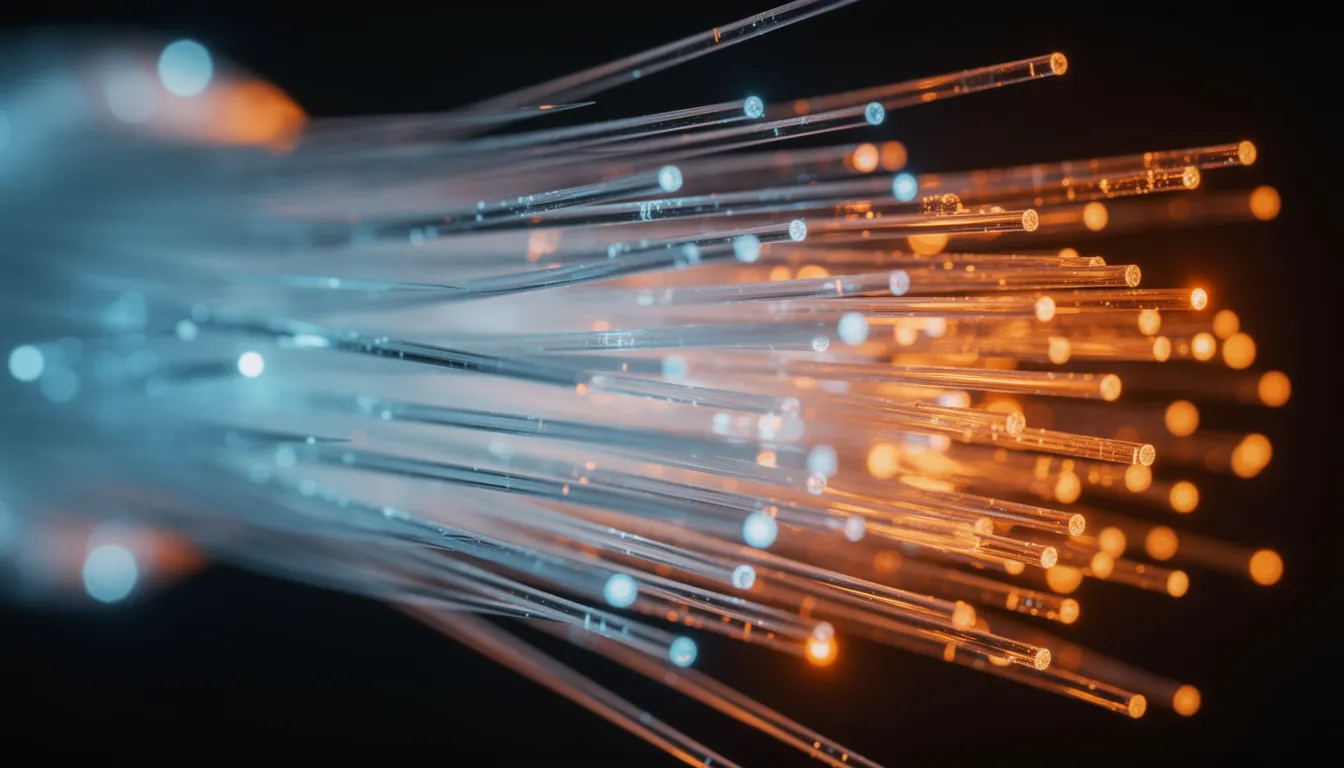
En esencia, la fibra óptica transmite datos como pulsos de luz a través de finos filamentos de vidrio o plástico. A diferencia de los cables de cobre que transportan señales eléctricas, la fibra óptica aprovecha el principio de reflexión interna total para guiar las señales luminosas con mínima pérdida a largas distancias.
Esto es lo que ofrecen las redes de fibra modernas:
-
Conexiones para hogares y pymes (FTTH): velocidades simétricas de 1 a 10 Gbps
-
Redes centrales y metropolitanas: 100-400 Gbps por longitud de onda a partir de 2024
-
Capacidad agregada: varios terabits por segundo en un solo par de fibras utilizando multiplexación por división de longitud de onda densa
Las redes de fibra óptica se estructuran en tres capas principales:
-
Capa central: conexiones de larga distancia que abarcan cientos o miles de kilómetros
-
Capa de metro: Redes regionales que conectan ciudades y principales puntos de agregación
-
Capa de acceso: la última milla que llega a hogares, empresas y sitios celulares 5G
Cada capa juega un papel crucial en el transporte 5G, garantizando que el flujo masivo de datos generado por millones de dispositivos llegue a los centros de datos y a la infraestructura de computación en la nube sin cuellos de botella.
Fibra vs. cobre: ¿Por qué ha cambiado la red troncal?
El cambio del cobre a la fibra no es una preferencia, sino una necesidad impulsada por la física. Aquí se comparan:
|
Factor |
Cobre (DSL/Coaxial) |
Fibra óptica |
|---|---|---|
|
Velocidades de acceso típicas |
Menos de 200 Mbps |
1-10 Gbps simétricos |
|
Distancia sin regeneración |
1-2 km (con degradación) |
40+ kilómetros |
|
interferencia electromagnética |
Altamente susceptible |
Completamente inmune |
|
Pérdida de señal por km |
5-20 dB |
0,2 dB a 1550 nm |
|
Techo de ancho de banda |
Limitado por propiedades eléctricas |
Prácticamente ilimitado |
El DSL basado en cobre presenta dificultades a más de unos pocos kilómetros y se degrada significativamente con la distancia. Mientras tanto, el cable de fibra monomodo mantiene la integridad de la señal a lo largo de decenas de kilómetros sin repetidores, con una atenuación de tan solo 0,2 dB/km en la longitud de onda de 1550 nm.
La inmunidad a las interferencias electromagnéticas es especialmente crítica en entornos urbanos, donde el ruido eléctrico de líneas eléctricas, motores y otras fuentes degradaría las señales de cobre. La fibra óptica no se ve afectada por la corrosión, las inclemencias del tiempo ni los campos electromagnéticos.
Los enormes volúmenes de tráfico de 5G hacen que la fibra, y no el cobre, sea el único medio de retorno realista a largo plazo.
Cuando una sola estación base 5G puede generar más de 10 Gbps de tráfico en horas punta, el cobre simplemente no puede seguir el ritmo. La infraestructura de cableado del futuro es el vidrio.
Cómo las redes 5G utilizan realmente la fibra óptica
Piensa en el 5G como un iceberg. La conexión inalámbrica entre tu dispositivo y la antena es la punta visible: aproximadamente el 10 % del trayecto. ¿El 90 % restante? Son redes de fibra óptica subterráneas, que cruzan océanos y centros de datos.
Considere la escala: para 2025, millones de estaciones base 5G en todo el mundo necesitarán conexiones de fibra multigigabit. Esto representa un cambio fundamental con respecto a la arquitectura 4G, donde una macrocelda podía cubrir una milla cuadrada. El denso despliegue de pequeñas celdas en 5G (aproximadamente 600 celdas por cada macrotorre 4G) aumenta drásticamente el número de puntos de terminación de fibra.
Los despliegues urbanos densos colocan pequeñas celdas en mobiliario urbano, fachadas de edificios y tejados. Cada una necesita conectividad. Normalmente, requiere fibra.
Fronthaul, Midhaul y Backhaul sobre fibra
Las redes 5G modernas dividen su arquitectura de transporte en tres segmentos distintos:
El fronthaul conecta las unidades de radio distribuidas (RU o AAU) en el emplazamiento de la antena con las unidades de banda base centralizadas (DU/CU). Estos enlaces requieren:
-
Latencia extremadamente baja (microsegundos, no milisegundos)
-
Alto ancho de banda (10-25 Gbps por enlace)
-
Transmisión ultra confiable para operación coordinada de múltiples celdas
Midhaul vincula las unidades distribuidas con funciones de procesamiento centralizadas, que normalmente abarcan unos pocos kilómetros.
El backhaul conecta sitios de agregación a redes centrales y metropolitanas, a menudo utilizando interfaces ópticas de 10G, 25G, 100G y, cada vez más, 400G.
Los protocolos e interfaces clave incluyen:
-
CPRI y eCPRI transmitidos a través de sistemas de multiplexación por división de longitud de onda
-
Especificaciones 5G X-haul para el transporte de fibra
-
WDM-PON para infraestructura compartida que da servicio tanto a sitios móviles como a banda ancha fija
Los operadores de telecomunicaciones implementan cada vez más infraestructura de fibra óptica compartida que presta servicio a conexiones residenciales, clientes comerciales y sitios 5G desde la misma planta de fibra, maximizando la eficiencia y satisfaciendo diversas demandas digitales.
Celdas pequeñas, redes densas y alcance de fibra
Las frecuencias 5G más altas generan un equilibrio que configura toda la arquitectura de la red. Las frecuencias de banda media de 3,5 GHz ofrecen un equilibrio entre velocidad y cobertura, mientras que las bandas de ondas milimétricas (24-100 GHz) ofrecen velocidades de varios gigabits, pero presentan las siguientes desventajas:
-
Corto alcance: normalmente menos de 200 metros
-
Mala penetración a través de paredes y ventanas
-
Requisitos de línea de visión
Esta realidad física se traduce directamente en los requisitos de fibra. Cada pequeña celda en una farola, cada microcelda en un centro comercial y cada sistema de antena interior suelen necesitar un enlace alimentado por fibra.
Ejemplo: Despliegue urbano denso
En ciudades como Seúl, Nueva York o Bombay, los operadores despliegan miles de pequeñas celdas interconectadas mediante anillos de fibra. Un solo kilómetro cuadrado podría contener:
-
Más de 50 pequeñas celdas para exteriores
-
Cientos de elementos de antena distribuidos en interiores
-
Múltiples puntos de agregación de fibras
Los desafíos prácticos son importantes:
-
Planificación y permisos para zanjas
-
Navegando por los servicios públicos subterráneos existentes
-
Enrutamiento de fibra en edificios a través de estructuras complejas
-
Coordinación con propietarios de inmuebles y municipios
Estas realidades de implementación (no solo las especificaciones tecnológicas) ahora determinan los plazos y los costos para lograr el rendimiento completo de la red 5G.
Tecnologías de fibra clave que impulsan las redes de la era 5G
Los filamentos de vidrio en bruto no son suficientes. Se están adoptando tecnologías y estándares de fibra específicos para satisfacer los exigentes requisitos de capacidad, latencia y capacidad de despliegue del 5G.
Los principales temas tecnológicos que impulsan la era 5G incluyen:
-
Multiplexación por división de longitud de onda densa para una capacidad masiva
-
Estándares PON de próxima generación (XGS-PON, 25G-PON, 50G-PON)
-
Fibras insensibles a la flexión y de diámetro micrométrico para instalaciones exigentes
-
Fibras de pérdida ultrabaja para un mayor alcance
-
Fibras de núcleo hueco para aplicaciones de latencia crítica
Estas innovaciones no son teóricas: se están implementando ahora para gestionar las demandas de transmisión de datos de las redes 5G.
Multiplexación por división de longitud de onda densa (DWDM) para una capacidad masiva
DWDM es la tecnología que transforma un solo cable de fibra en el equivalente a docenas de canales independientes. Al utilizar diferentes longitudes de onda (colores) de luz, se pueden transmitir múltiples señales simultáneamente en la misma fibra física.
Así es como funciona en la práctica:
-
Cada longitud de onda transporta entre 10 y 400 Gbps de datos.
-
Los sistemas comerciales apilan entre 40 y 96 longitudes de onda en un solo par de fibras
-
Las implementaciones avanzadas alcanzan hasta 64 canales a 400 Gbps cada uno
-
Capacidad agregada: 25,6 Tbps por par de fibras
Para 5G, la tecnología DWDM es fundamental para agrupar el tráfico de miles de estaciones base en unas pocas rutas ópticas de alta capacidad. En lugar de tender fibras separadas a cada destino, los operadores multiplexan el tráfico de múltiples fuentes en longitudes de onda compartidas, lo que mejora drásticamente la eficiencia.
Tecnologías como PAM4 (modulación de amplitud de fase de cuatro niveles) duplican la densidad de datos al codificar dos bits por símbolo en lugar de uno. La óptica autoajustable puede asignar longitudes de onda dinámicamente en minutos sin intervención manual, lo cual es esencial para el rápido escalamiento de las redes 5G.
PON de próxima generación (XGS-PON, 25G-PON, 50G-PON)
Las redes ópticas pasivas utilizan divisores sin alimentación para compartir la infraestructura de fibra entre múltiples terminales. Esta arquitectura cumple cada vez más una doble función: ofrecer servicios residenciales de gigabit y proporcionar backhaul 5G desde la misma planta de fibra.
|
Estándar PON |
Velocidad simétrica |
Estado |
|---|---|---|
|
GPON |
2,5 Gbps de bajada / 1,25 Gbps de subida |
Ampliamente implementado |
|
XGS-PON |
10 Gbps simétricos |
Estándar actual |
|
25G-PON |
25 Gbps simétricos |
Ensayos de campo |
|
50G-PON |
50 Gbps simétricos |
Ratificado por la UIT-T |
Los beneficios del 5G son sustanciales:
-
La infraestructura compartida reduce los costos de implementación
-
La baja latencia cumple con los requisitos de backhaul móvil
-
Ruta de actualización sencilla para obtener una mayor capacidad con respecto a la fibra existente
Un solo árbol PON puede servir a hogares, empresas y pequeñas celdas 5G en conjunto, maximizando el retorno de la inversión en fibra y al mismo tiempo satisfaciendo diversas necesidades de conectividad.
Fibras insensibles a la flexión y de diámetro micrométrico
La densificación del 5G permite que la fibra óptica entre en entornos difíciles: conductos estrechos, esquinas pronunciadas en edificios y sistemas de conductos abarrotados en ciudades antiguas. La fibra tradicional sufriría pérdida de señal por curvatura. Los diseños modernos insensibles a las curvaturas solucionan este problema.
Los tipos de fibra insensibles a la curvatura según la norma ITU-T G.657 permiten:
-
Instalación en curvas de radio de 5 mm sin pérdida de señal significativa
-
Implementaciones de microestaciones base en interiores de edificios complejos
-
FTTH en estructuras residenciales con estrictas restricciones de enrutamiento
Las fibras recubiertas con un diámetro micrométrico (recubrimientos de 180-200 µm en comparación con el estándar de 250 µm) permiten un mayor número de fibras por cable. Esta mayor capacidad es importante cuando el espacio en los conductos es limitado, una situación común en ciudades con infraestructuras antiguas.
Ejemplo práctico: Una ciudad europea antigua con servicios subterráneos centenarios podría tener espacio para 48 fibras estándar. Con diseños de menor diámetro, los operadores pueden instalar 96 o 144 fibras en el mismo espacio, lo que permite dar soporte a muchos más sitios 5G sin necesidad de nuevas obras civiles.
Fibras de pérdida ultrabaja y gran área efectiva
Para las redes troncales 5G de larga distancia que conectan ciudades y países, cada decibelio de pérdida de señal importa. Las fibras G.654.E de pérdida ultrabaja amplían el alcance de las longitudes de onda de alta capacidad:
-
Una menor atenuación significa que las señales viajan más lejos antes de la regeneración.
-
Un área efectiva más grande reduce las penalizaciones no lineales en niveles de alta potencia
-
La relación señal-ruido óptica mejorada admite canales de 200G, 400G y 800G
Los resultados prácticos para las redes troncales 5G nacionales:
-
Menos sitios de regeneración (menos equipos, menor consumo de energía)
-
Transporte de larga distancia más económico
-
Mayor capacidad por par de fibras
Esto es importante al conectar regiones remotas a redes centrales. La misma infraestructura de fibra óptica que da servicio al backhaul 5G puede soportar la conectividad empresarial, el tráfico de computación en la nube y las interconexiones de centros de datos.
Fibras huecas e innovaciones futuras
La fibra estándar guía la luz a través del vidrio sólido. Las fibras de núcleo hueco adoptan un enfoque diferente: la luz viaja principalmente a través del aire en un centro hueco, confinado por un revestimiento estructurado.
El beneficio potencial es significativo: la luz viaja aproximadamente entre un 30 % y un 50 % más rápido a través del aire que a través del vidrio. Para aplicaciones que exigen la menor latencia posible (comercio de alta frecuencia, control industrial de tiempo crítico, sistemas autónomos en tiempo real), esto podría ofrecer ventajas significativas.
Estado actual:
-
Implementaciones comerciales tempranas en aplicaciones especializadas
-
Aún no se utiliza ampliamente en las redes troncales 5G
-
Investigación y desarrollo activos por parte de los principales fabricantes de fibras
Las fibras de núcleo hueco representan hacia dónde se dirige la innovación en fibra durante la próxima década, permitiendo potencialmente nuevas categorías de aplicaciones sensibles a la latencia que no son posibles con fibras ópticas convencionales.
Inteligencia, automatización y confiabilidad en redes 5G de fibra
La capacidad por sí sola no basta. Cuando millones de usuarios de 5G y miles de millones de dispositivos IoT dependen de la misma infraestructura de fibra óptica, las redes deben ser inteligentes, autorreparables y operativamente eficientes a gran escala.
Las modernas redes 5G que priorizan la fibra integran:
-
Monitoreo impulsado por IA y mantenimiento predictivo
-
Redes definidas por software para la asignación dinámica de recursos
-
Segmentación de red para atender diversas aplicaciones con diferentes requisitos
El objetivo: alto tiempo de actividad, rápida resolución de fallas y conectividad perfecta en toda la infraestructura.
Monitoreo y mantenimiento predictivo impulsados por IA
Los sistemas de IA ahora analizan la telemetría de la red óptica en tiempo real en todo el conjunto de fibra. Esto incluye:
-
Trazas de OTDR (reflectómetro óptico en el dominio del tiempo)
-
Niveles de potencia óptica en cada nodo
-
Estadísticas de errores y tasas de errores de bits
-
Datos de temperatura y ambientales
Los algoritmos de aprendizaje automático detectan patrones que indican problemas potenciales antes de que provoquen interrupciones:
-
Degradación de la fibra por estrés ambiental
-
Microcurvas por manipulación inadecuada del cable
-
Posibles descansos de la actividad de construcción cercana
Impacto en el mundo real: En lugar de horas de investigación manual tras una interrupción, los sistemas de IA proporcionan alarmas casi instantáneas y gestión automatizada de incidencias. Se puede identificar una falla en desarrollo y programar su reparación antes de que los consumidores o usuarios de 5G experimenten alguna degradación.
En el caso específico del 5G, esta fiabilidad es crucial, ya que una sola rotura de fibra podría afectar simultáneamente a miles de usuarios móviles y sistemas críticos del IoT. El mantenimiento predictivo garantiza que la infraestructura digital se anticipe a las fallas.
SDN, segmentación de red y flexibilidad de la capa óptica
Las redes definidas por software (SDN) ofrecen control programable a las redes de fibra óptica. Los controladores asignan dinámicamente longitudes de onda y ancho de banda según la demanda en tiempo real y los requisitos del segmento 5G.
La segmentación de red crea redes virtuales separadas en una infraestructura compartida:
-
Segmento de banda ancha para el consumidor: optimizado para el rendimiento
-
Segmento de VPN empresarial: priorizando la seguridad y la confiabilidad
-
Segmento de baja latencia ultra confiable: para comunicaciones críticas y automatización industrial
Tecnologías clave que permiten esta flexibilidad:
-
ROADM (Multiplexores ópticos reconfigurables de adición/eliminación): dirigen longitudes de onda a diferentes rutas sin intervención manual
-
OXC (Conexiones cruzadas ópticas): Conmutan señales ópticas entre fibras en los nodos principales
-
Transceptores autoajustables : ajuste la longitud de onda y la modulación según demanda
El impacto comercial es considerable. Los operadores pueden implementar nuevos servicios 5G sin construir nuevas redes físicas cada vez. Por ejemplo, un servicio premium de videojuegos de baja latencia puede implementarse en la fibra existente asignando capacidad de longitud de onda dedicada, sin necesidad de excavar zanjas.
Casos de uso habilitados por 5G con respaldo de fibra
Al combinar el internet de alta velocidad de la fibra con la flexibilidad inalámbrica del 5G, se posibilitan aplicaciones completamente nuevas. No se trata de futuros teóricos: se están implementando ahora y crecerán drásticamente en los próximos años.
La calidad de la experiencia depende tanto de la capa de radio 5G como de las redes de fibra óptica subyacentes. Una infraestructura de fibra deficiente implica un rendimiento 5G deficiente, independientemente del avance de la tecnología inalámbrica.
Entretenimiento inmersivo, juegos en la nube y medios
Las demandas digitales de la industria del entretenimiento están en auge. Consideremos lo que requieren las experiencias modernas:
|
Solicitud |
Necesidad de ancho de banda |
Requisito de latencia |
|---|---|---|
|
Transmisión en 4K |
25-50 Mbps |
Menos de 100 ms |
|
Transmisión en 8K |
80-100 Mbps |
Menos de 100 ms |
|
Juegos en la nube |
35-75 Mbps |
Menos de 20 ms |
|
VR/RA inmersiva |
100-500+ Mbps |
Menos de 10 ms |
La fibra óptica hasta el hogar, combinada con la cobertura 5G en interiores y exteriores, ofrece experiencias fluidas en todos los dispositivos. Tus partidas te siguen del televisor a la tableta y al teléfono sin interrupciones.
Ejemplos concretos:
-
Deportes en vivo en 8K con selección de cámara multivista
-
Conciertos de realidad virtual donde miles de asistentes interactúan en tiempo real
-
Juegos en la nube que rivalizan con el rendimiento de la consola local
Estas experiencias se basan en nodos de computación de borde alimentados por fibra, que procesan contenido cerca de los usuarios para minimizar la latencia mientras 5G proporciona la conexión inalámbrica final.
Ciudades inteligentes e IoT masivo
Las ciudades modernas están implementando infraestructura conectada a gran escala:
-
Semáforos inteligentes que optimizan el flujo en tiempo real
-
Sensores ambientales que monitorean la calidad del aire y el ruido
-
Sistemas de CCTV conectados con análisis basados en IA
-
Monitoreo de servicios públicos para redes de energía, agua y gas
El 5G conecta estos puntos finales, mientras que la fibra óptica concentra el flujo continuo de datos en los centros de datos perimetrales y centrales para su procesamiento. Una sola implementación de ciudad inteligente podría incluir:
-
Decenas de miles de sensores conectados
-
Cientos de nodos de computación de borde
-
Múltiples anillos de fibra redundantes garantizan que los sistemas críticos permanezcan en línea
Para 2030, las proyecciones sugieren que habrá decenas de miles de millones de dispositivos IoT a nivel mundial, generando flujos de datos continuos que solo una infraestructura con respaldo de fibra puede gestionar. Los requisitos de rendimiento de la red (manejo de grandes archivos de datos de sensores y análisis en tiempo real) exigen la mayor capacidad que solo la fibra ofrece.
Industria 4.0, automatización y 5G privado
Los sectores de fabricación y logística están adoptando redes 5G privadas para plantas de producción, almacenes y entornos universitarios. Estas redes requieren conexiones de fibra dedicadas para ofrecer:
-
Coordinación robótica en tiempo real con temporización de microsegundos
-
Control de calidad de visión artificial que procesa millones de imágenes
-
Vehículos guiados autónomos que navegan en entornos dinámicos
-
Sistemas gemelos digitales en constante evolución con datos de producción
Ejemplo de implementación: Una planta automotriz moderna podría utilizar 5G privado con una cobertura de 500.000 metros cuadrados, alimentada por múltiples conexiones de fibra de 100G a la computación en el borde local. El rendimiento determinista necesario para la automatización crítica para la seguridad exige fibra desde la planta hasta los nodos de computación locales a pocos kilómetros.
El diseño robusto de fibra en las instalaciones industriales y sus alrededores se convierte en un componente fundamental de los proyectos de transformación digital. El diseño innovador de estas redes, que combina la flexibilidad inalámbrica con la fiabilidad de las redes cableadas, permite mejoras de eficiencia que justifican una importante inversión en infraestructura.
Atención médica remota y comunicaciones críticas
Las aplicaciones sanitarias exigen los requisitos de fiabilidad y latencia más estrictos:
|
Caso de uso |
Objetivo de latencia |
Necesidad de confiabilidad |
|---|---|---|
|
Diagnóstico remoto |
Menos de 50 ms |
99.9% |
|
Asistencia de telecirugía |
Menos de 5 ms |
99,999% |
|
telemetría de ambulancia |
Menos de 20 ms |
99,99% |
|
Dispositivos médicos conectados |
Menos de 100 ms |
99.9% |
Los escenarios de cirugía remota —donde un especialista guía o controla instrumentos quirúrgicos robóticos desde otra ubicación— requieren una latencia extremadamente baja y tolerancia cero a las interrupciones de la red. La pérdida de un solo paquete podría tener un impacto significativo en los resultados del paciente.
Estas aplicaciones requieren:
-
Rutas de fibra altamente redundantes con conmutación por error automática
-
Monitoreo de extremo a extremo con alertas instantáneas
-
Cumplimiento normativo para la conectividad de dispositivos médicos
-
Energía de respaldo y seguridad física para nodos críticos
La infraestructura digital que sustenta la conectividad sanitaria debe cumplir estándares que van mucho más allá de los servicios habituales para el consumidor. Su construcción requiere planificación, inversión y un seguimiento continuo que priorice la fiabilidad.
Hacia 6G y más allá: el futuro de las redes de alta velocidad basadas en fibra
Mientras los lanzamientos de 5G continúan a nivel mundial, los laboratorios de investigación ya están trabajando en 6G, previsto para alrededor de 2030. El patrón es claro: cada nueva generación móvil depende de fibra óptica mejorada para lograr capacidad y alcance.
Las ambiciones del 6G incluyen:
-
Velocidades máximas cercanas a 1 Tbps
-
Soporte para comunicaciones holográficas
-
Integración de frecuencias de terahercios (100 GHz - 10 THz)
-
Arquitecturas de red nativas de IA
-
Capacidades de detección y posicionamiento integradas en la conectividad
Ninguno de estos avances es posible sin la correspondiente innovación en la tecnología de la fibra.
Áreas de investigación en curso:
-
Fibras multinúcleo: Múltiples núcleos portadores de luz en una sola fibra, multiplicando la capacidad
-
Espectro óptico ampliado: uso de bandas C+L y más allá para apilar más longitudes de onda
-
Integración radio-óptica más estrecha: planos de control unificados que gestionan recursos tanto inalámbricos como de fibra
-
Distribución de claves cuánticas: uso de fibra para canales de comunicación ultraseguros
La trayectoria de desarrollo es inequívoca. Las tecnologías inalámbricas seguirán avanzando, ofreciendo velocidades más rápidas y nuevas capacidades. Sin embargo, cada avance requerirá mayor capacidad de la infraestructura de fibra subyacente.
Tendencias clave para una planificación a prueba de futuro:
-
Invertir en infraestructura de fibra que admita actualizaciones multigeneracionales
-
Diseño para longitudes de onda de mayor capacidad (400G, 800G y más)
-
Incorpore redundancia e inteligencia en la arquitectura de red
-
Plan para muchos más puntos de terminación de fibra a medida que aumenta la densidad celular
Conclusiones clave
La convergencia de la fibra óptica y el 5G representa más que una tendencia tecnológica: es la base del mundo digital para la próxima década y más allá.
Qué significa esto para la planificación de la red:
-
La tecnología 5G es tan buena como su fibra óptica: invierta en consecuencia
-
Las implementaciones densas de celdas pequeñas requieren proporcionalmente más puntos de terminación de fibra
-
Tecnologías como DWDM, PON de próxima generación y fibra insensible a las curvaturas son facilitadores esenciales
-
La automatización impulsada por IA y la segmentación de red maximizan el valor de la infraestructura
-
Planificar el 6G significa construir hoy redes de fibra inteligentes y actualizables
Papel crítico de la convergencia:
La fibra óptica proporciona la capacidad, la latencia y la fiabilidad que la tecnología inalámbrica por sí sola no puede ofrecer. El 5G proporciona la flexibilidad y la movilidad que las conexiones cableadas no pueden igualar. Juntos, ofrecen la conectividad fluida de la que dependen cada vez más consumidores, empresas y ciudades enteras.
Las organizaciones que comprenden esta simbiosis e invierten en una infraestructura de fibra óptica sólida que respalde tecnologías inalámbricas en constante evolución estarán posicionadas para aprovechar las oportunidades de un futuro cada vez más conectado.
Ya sea que usted sea un operador de telecomunicaciones que planifica actualizaciones de red, una empresa que evalúa opciones de conectividad o un líder tecnológico que da forma a una estrategia digital, el mensaje es claro: la fibra óptica y el 5G juntos definen el futuro de las redes de alta velocidad.
- Compartir en:
- Deel
- Tweet
- Póngale un alfiler.
- Messenger
- Correo electrónico